


Nintendo SpaceWorld 1997 |
|
For three quick days in November, Nintendo unbolted its doors and let its Tokyo public take a sneak peek into its not-so-distant future. At Nintendo SpaceWorld 1997, the namesake company showcased a bundle of upcoming Nintendo 64 games and revealed a stunning intent for radical change. Held at Tokyo's Makuhari Messe, the amped-up show drew almost a quarter of a million visitors, plus journalists from all corners of the globe, proving Nintendo's hold on the Japanese public remains as formidable as ever. The undisputed star of the event was Zelda 64, now called: The Legend of Zelda: Ocarina of Time. This cart in all its unbelievable hype represents a massive leap forward for Nintendo's internal development team compared to Mario 64. The game's unique 3-D targeting system, cinematic camera views, and refined play control made the floor demo instantly impressive to our team, while exhilarating boss encounters and eye-popping story sequences gave Link's adventure a movie-like atmosphere. Nearby Zelda loomed other polished N64 treats such as Rare's Banjo-Kazooie, F Zero X, 1080 Snowboarding, NBA Courtside, and a completed Yoshi Story. |
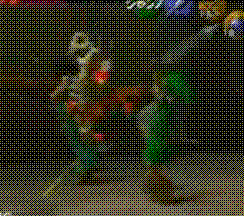 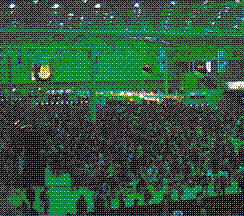 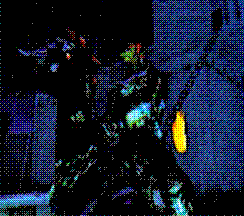 Targeting in Zelda 64 SpaceWorld Crowds A Mysterious Foe Appears |
|
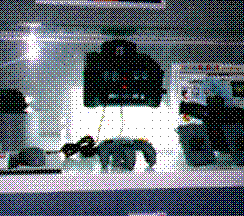
Nintendo's senior figures stood out from the crowd to make their plea. Company President Hiroshi Yamauchi delivered a keynote speech outlining a strategy to place Tamagotchi-style games and their Japan-exclusive Pocket Monsters at the nucleus of Nintendo's future. The prez emphasized collecting and trading as key impulses for the next generation of play and suggested a curious concept of never-ending games. Famed Mario creator Shigeru Miyamoto spent a great deal of time demonstrating upcoming N64 entries whilst explaining Nintendo's clear intent to shape this new direction as described by Yamauchi. Though the games shown off at this event were generally of high quality, several highly anticipated projects failed to materialize, including projected 64DD launch title Mother 3. Delays continue to plague most major releases with release date specificities once more eluding the public. Yet for many visitors, especially Japanese fans, the excitement around Pocket Monsters and the strength of Nintendo's first-party games compensated for the lack of big stunners. SpaceWorld's showcase areas likewise reflected Nintendo's shifting priorities. The exhibition hall was carefully divided between Nintendo 64 software, demonstrations of the 64DD, Game Boy peripherals, and an extensive Pocket Monsters area. The largest proportion of the floor space was dedicated to the world of portables, from the popular Pocket Monsters scene to new Game Boy accessories such as the GB Pocket Camera and Printer. Demand for admission to this area in particular appeared so intense that over 100,000 visitors applied for the opportunity to download a special Pocket Monster at the show, prompting Nintendo to hastily develop a lottery system. Hidden neatly behind glass and deliberately kept out of players' hands sat the most intriguing part of the show: the Nintendo 64 Disk Drive. The 64DD was once presented simply as a cheaper, higher capacity alternative to cartridges, but at SpaceWorld it became evident that this perspective has been completely flipped. Nintendo now positions their add-on as a bridge between the Nintendo 64 and the Pocket Monsters phenomenon, and as a family-friendly creative platform. Entry to the 64DD portion of the show was generally tightly managed, with guests given time-sensitive badges in order to cope with enormous queues. |
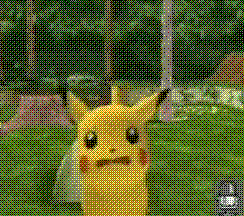   Pikachu Genki Dechu The Nintendo 64DD Creator Game for 64DD |
|
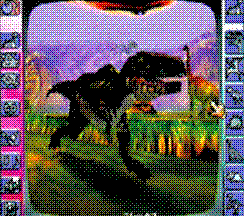
The ultimate design and use of the 64DD remains unchanged from its initial reveal years ago. 64DD allows the Nintendo 64 to utilize magnetic disks, both reading and writing up to 64 megabytes. Nintendo asserts the high-speed nature of DD disks, claimed to be faster than standard CDs, and further professed a real-time clock system will be present within the disks to support gameplay changes based on time and date. As for the concept of internet connectivity, well, that feature vanished altogether. The Japanese launch is set (for now) at June '98, and any release outside Japan is uncertain. The lead 64DD title shown at the event was Pocket Monsters Stadium. Through use of a special controller accessory capable of reading Game Boy carts, players will be able to transfer monsters to the N64 and observe them battle in fully rendered 3-D. For fans, the appeal is obvious. Two other related projects, Pocket Monsters Snap and Pikachu Genki Dechu, focusing on photography-based gameplay and voice recognition systems respectively, were also showcased. Additional 64DD projects revealed at SpaceWorld were Mario Artist and the Maker-line of products. Talent Maker, Picture Maker, and Polygon Maker together form a creative toolkit for players to draw, build and animate models using an N64 mouse as well as import images from video cameras or VCRs. These programs can exchange data with one another, thereby allowing pictures, objects and textures to be reused across the array of Maker titles. Miyamoto, always forward-thinking, described how this compatibility could extend into games such as SimCity 64 and SimCopter, where players could theoretically fly through cities that they designed themselves. This new emphasis on creativity and interconnection has somewhat divided audiences. Nintendo appears adamant that its core Japanese market is moving away from traditional console games and toward social forms of play (Pocket Monsters) and exchangeable creative design (64DD). As for those of us searching for a 3-D Metroid or news about Mario RPG 2, we'll be stuck waiting for E3. |


Click the Arrow Blocks to Navigate Through Our Spotlight Features
